
Lead management for small businesses often fails in tiny, preventable ways. Here’s how most small businesses process their leads: after a call, their leads’ details land in an inbox. A sales rep writes a quick note, then days pass, and nobody remembers who was meant to call back.
Sound familiar?
Lead management for small businesses comes down to one idea: every enquiry gets recorded, assessed, and followed up the same way. When lead data is spread across emails and individual notes, a lot of key information gets lost along the way.
A clear sales process fixes that, and this guide shows you how to build one.
What You’ll Learn:
-
How to capture every enquiry in one place, with the source, date, and next action recorded.
-
How to qualify leads early so your time goes to the prospects most likely to buy.
-
How to set a response-time target and schedule every follow-up instead of relying on memory.
-
When you should use a lead tracking system as your team and enquiries grow.
What Is Lead Management for Small Businesses?
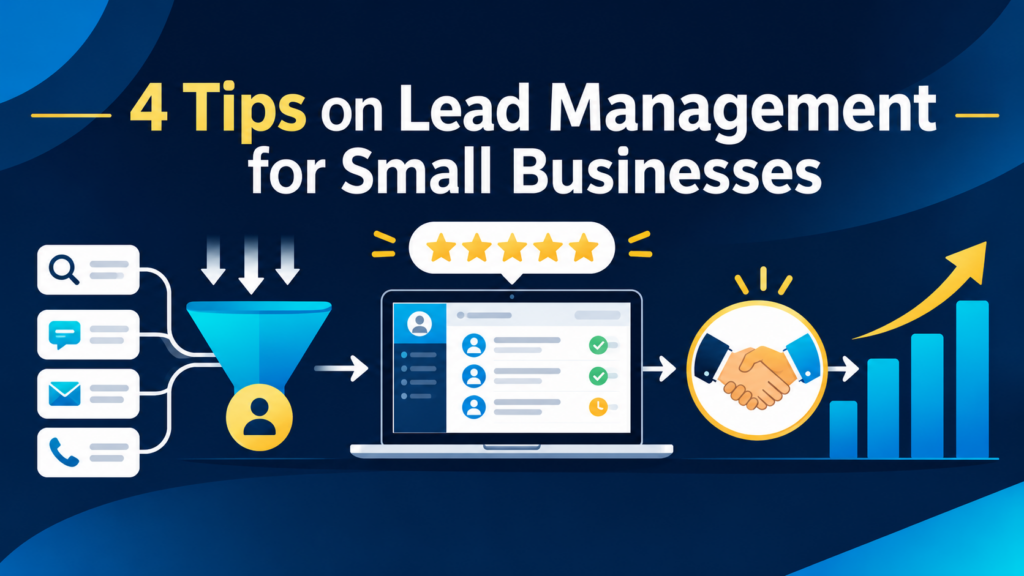
Lead management is the process of capturing, organising, qualifying and following up with each potential customer until they make a decision. It covers four main stages:
Stage #1: Lead capturing
Collecting enquiries from website forms, email, phone calls, referrals, and other channels.
Stage #2: Lead qualification
Checking whether a prospect fits your target market and has a genuine need.
Stage #3: Lead nurturing
Keeping in touch with prospects who aren’t ready to buy yet.
Stage #4: Follow-up and conversion
Guiding qualified prospects towards a purchase or an agreed next step.
Does Lead Management Include Lead Generation Activities?
Lead management also differs from lead generation. Lead generation attracts people to your business through advertising, search, and referrals. Lead management starts once someone makes contact and helps you guide them through the customer journey. You can generate plenty of enquiries and still lose most of them without it.
4 Tips On How to Manage Sales Leads Effectively
Knowing how to manage sales leads doesn’t require a complicated system. It takes four habits, applied consistently.
Tip #1: Keep Lead Management for Small Businesses in One Place
Store every enquiry in one accessible place. Record the contact details, enquiry source, date received, what the customer needs, communication history, and the next action. When a customer calls back, anyone on the team can pick up where the last conversation ended.
Tip #2: Qualify and Prioritise Leads
A general question about opening hours is very different from a prospect with a budget, a time frame, and a clear need. Assess each lead’s:
-
Needs
-
Budget
-
Time frame
-
Suitability
-
Level of interest
Then focus on prioritising leads based on their engagement and readiness to buy.
Many businesses give each enquiry a simple lead score, such as 1 to 5, to make this quick. It separates qualified leads from early-stage enquiries and tells you who to call first.
Tip #3: Assign Responsibility
Give every lead one owner. When an enquiry belongs to “the team”, nobody feels accountable and it gets overlooked. A named owner, such as the business owner or one of your sales reps, knows that the lead is theirs to progress.
Tip #4: Record Every Next Step
Write down follow-up dates, open questions and agreed actions straight after each conversation. Memory fails when you’re busy. A note like “send quote Thursday, call Friday” keeps each opportunity moving through your sales pipeline.
How to Build a Reliable Lead Follow-Up Process
Prospects lose interest quickly. If they hear nothing back, or receive unclear communication, they’ll often contact a competitor instead. If you want to have a solid follow-up process, you should have:
-
A response-time target that suits your business, such as the same business day.
-
The right channel for each prospect, such as email or a phone call.
-
A message personalised to the original enquiry rather than a generic template.
-
A scheduled next contact when a decision is still pending.
-
A recorded outcome for every interaction.
-
Clear rules for when a lead receives further follow-up, enters a nurturing sequence, or is marked inactive.
How often you follow up should reflect the prospect’s needs, urgency, and preferences. A homeowner requesting a bathroom renovation quote will move at a different pace from a business buying accounting services, so don’t copy a schedule from another industry. Avoid excessive contact too. Too many messages can push a potential customer away.
Did You Know? A 2011 Harvard Business Review study of online sales enquiries in the United States found that, among companies that responded within 30 days, the average first response took 42 hours. That gap is where a clear follow-up process makes a difference.
Official Source:
-
The Short Life of Online Sales Leads – Peer-reviewed article by Oldroyd, McElheran and Elkington, Harvard Business Review, 2011.
Not sure where your enquiries are slipping through the cracks?
Book Your FREE 30-Minute Consultation. Have questions? Call our team on +61 7 5600 0989
Do You Really Need A Lead Tracking System?
A lead tracking system records each enquiry and shows its status, from first contact through to conversion. The most useful capabilities include:
-
A central record of every lead and its contact history.
-
Lead status tracking and sales pipeline stages.
-
Reminders for outstanding follow-ups.
-
Assignment of leads to responsible team members.
-
Reporting on enquiry sources, conversion rates, and stalled opportunities.
The system also shows which sources lead to closed deals, so you can put your effort where it pays off.
A spreadsheet can be enough when you handle a small, manageable number of enquiries. A dedicated lead management system starts to earn its place when several people handle leads, enquiries arrive through multiple channels, or manual tracking causes delays and errors. Zoho CRM, for example, lets you capture website enquiries through web forms straight into a lead record, so nothing depends on someone copying details across by hand.
When Should a Small Business Consider Sales Lead Management Software?
Software becomes useful when you struggle to track follow-ups, keep accurate records, share information with team members, or report on sales performance. If your team regularly asks, “Who’s contacted this customer?”, it’s probably time to look.
Keep your assessment practical. These are the features worth checking:
-
Contact and enquiry management.
-
Follow-up reminders and task management.
-
Lead qualification and scoring.
-
Sales pipeline visibility and reporting.
-
Integration with your existing email, website forms, or marketing tools.
-
Ease of use, scalability, and cost.
A CRM may include lead management capabilities, but products differ. Assess what each platform offers rather than assuming they all work the same way. Scoring and automation features, for example, can depend on the edition you choose.
Zoho CRM is the platform we set up for Australian businesses. It includes assignment rules that route new leads to the right sales rep, scoring rules that help prioritise records, and workflow rules that can create follow-up tasks and send notifications automatically.
If you’re comparing options for a smaller team, our page on CRM for small businesses will show you where to start.
How Lead Nurturing Helps Move Prospects Towards a Purchase
Not every prospect is ready to buy at first contact. Some need more information, internal approval, budget confirmation, or time to compare options. The process of nurturing a lead keeps your business front of mind until they’re ready to decide.
Practical lead nurturing methods include:
-
Providing information that answers the prospect’s questions.
-
Sharing relevant case studies or details about your products or services.
-
Following up after a quotation or demonstration.
-
Using appropriate marketing campaigns to maintain engagement.
-
Reviewing lead status as the prospect’s circumstances change.
Done well, nurturing supports prospects through the sales funnel and helps you spot changes in readiness to buy, such as a prospect suddenly asking about pricing or timing.
Important: Keep your communication relevant and respectful. Follow the marketing and privacy requirements that apply to your business, including the Spam Act 2003 for commercial emails and text messages.
Common Lead Management Mistakes You Need to Avoid
Most problems with managing leads come from a handful of habits:
-
Keeping enquiry details across disconnected tools.
-
Failing to respond promptly to new enquiries.
-
Treating every prospect as equally qualified.
-
Forgetting to record conversations and next steps.
-
Following up without considering the customer’s needs.
-
Measuring enquiry volume without tracking how many become closed deals.
-
Using a complicated system that staff don’t maintain.
The most effective approach is the one your team follows consistently. Review your sales process regularly, identify where qualified leads stall, and adjust your lead follow-up process based on actual results rather than assumptions.
Build a More Consistent Lead Management Process
Effective lead management for small business starts with clear procedures: centralise lead information, qualify opportunities, build a reliable follow-up process, and review sales progress regularly. Tracking tools and sales lead management software then support those procedures as your enquiry volumes and team grow.
Take a look at how you handle enquiries today and where leads get forgotten. If you’d like help working out how to manage sales leads with better tracking, follow-up or Zoho CRM functionality, book a free 30-minute consultation or call our team on +61 7 5600 0989 to talk through lead management for small businesses.